
Mini Motorways is often described as the “road” answer to Mini Metro’s “rail” concept, but that shorthand doesn’t fully explain why it has held attention for years. As of 2026, it’s still one of the cleanest traffic-management games on mobile, not because it tries to simulate every real-world detail, but because it turns urban growth into a readable, strategic puzzle. You draw roads, place upgrades, react to new districts, and try to prevent the entire city from locking up.
From lines on a map to living traffic: what changed in the core gameplay
The biggest improvement over Mini Metro is how the city feels “alive” in motion. Instead of passengers flowing through stations, you manage individual vehicles heading to specific destinations. That shift sounds cosmetic at first, but it changes your priorities: intersections matter, merging matters, and route choice becomes a constant pressure. Traffic jams are visible, predictable, and often solvable if you read the flow properly.
Mini Motorways also gives you more direct control over the network. In Mini Metro you’re mostly arranging lines and managing capacity; here you can re-route a single neighbourhood, create dedicated loops, and use motorways to bypass problem zones. It’s still minimalist, but the decision space is wider, because every drawn segment can either relieve or cause congestion.
On mobile (Android and iOS), the touch interface suits this style surprisingly well. It’s quick to sketch new roads, pinch out for planning, and redraw in seconds when the weekly upgrade arrives. The game’s pacing encourages short sessions, but the strategic layer is deep enough that you’ll start thinking two or three “weeks” ahead.
Why roads are harder than rails — and why that’s a good thing
Trains in Mini Metro follow your lines; cars in Mini Motorways negotiate intersections, turning angles, and lane conflicts. That makes the game more demanding, but also more satisfying. A “good” solution isn’t just connecting shapes — it’s building a network that handles growth without collapsing under its own success.
The introduction of roundabouts and traffic lights as upgrades is another real step forward. These tools don’t just add variety; they force you to recognise patterns. Roundabouts reduce conflict at busy junctions, while traffic lights can stabilise messy crossroads — but only if you place them where flow is truly competing. Using them randomly wastes precious upgrades.
Motorways (the limited high-speed roads) add a layer that Mini Metro never needed: bypass strategy. You’re not simply improving capacity; you’re creating fast corridors that can rescue an overgrown district or connect an isolated pocket. Because the number is limited, every motorway placement feels like a long-term commitment rather than a quick fix.
Quality-of-life and modes: what improved beyond the basic loop
As of 2026, the game’s long-term strength is how it has expanded without losing clarity. New city maps arrive as content updates, but the interface stays consistent and easy to read. You’re not buried under menus; most of the work happens on the map, where the problems are visible and the fixes are immediate.
One of the most noticeable upgrades in recent years is the broader set of play modes. The game started with a familiar “survive as long as possible” structure, but later updates added ways to play for creativity, experimentation, or challenge. This matters because not everyone wants the same pressure: some players want a calm planning sandbox, while others want tight optimisation.
Another improvement is how the game encourages learning without heavy tutorials. It teaches through consequences: a bad intersection shows you exactly where cars stall; a misplaced motorway shows you the mismatch between speed and destination. The feedback loop is clean, so players feel responsible for both failures and fixes.
Creative Mode and the shift from survival to design
A major step forward for the community was the arrival of Creative Mode, released as a free update across Apple Arcade, Steam, and Nintendo Switch in 2025. Even if you mainly play on mobile, this matters because it reflects a design direction: Mini Motorways is no longer only about surviving longer, but also about building smarter and more beautiful networks.
Creative Mode changes the tone of the experience. Instead of reacting to constant pressure, you can experiment with layout ideas, redesign neighbourhoods, and test how certain patterns behave. For players who love the “planning” part more than the “panic management” part, this mode makes the game feel closer to a design toy — without turning it into a full city builder.
It also improves skill in the normal modes. When you can test intersection designs and motorway placement calmly, you learn principles that carry over into Expert or Endless. That’s an example of a practical improvement: a new feature that doesn’t just add content, but helps players understand the system more deeply.
Content updates and map design: what feels more modern by 2026
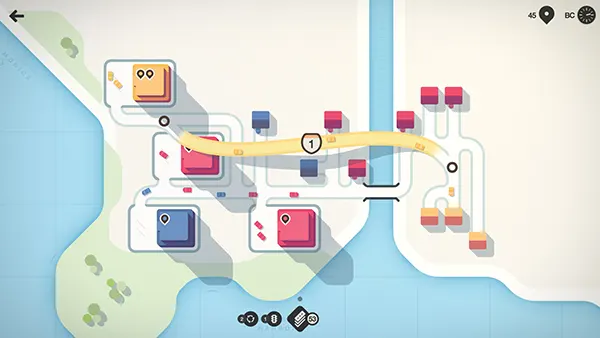
Mini Motorways has stayed relevant because its maps are not just cosmetic backdrops. Each city introduces new constraints — rivers, bridges, long highways, dense centres — which forces you to rethink your usual habits. A strategy that works in one map can collapse immediately in another, and that variety keeps the loop fresh without needing complex new mechanics.
Updates have also brought in city-specific mechanics that feel natural. For example, some later updates introduced elements like ferries on certain maps, adding another planning problem: water divides the city, and commuters still need to cross it efficiently. That’s the kind of change that fits the game’s style — simple in concept, tricky in execution.
By 2026, the game’s “sequel improvement” over Mini Metro is clear: it has more room for variation. The cities, the upgrades, and the road-based movement allow more distinct solutions, which means players can develop their own style rather than repeating the same blueprint every run.
What Mini Motorways does better than Mini Metro in the long run
Mini Metro is elegant because it stays abstract. Mini Motorways keeps the same clean visual language, but it adds just enough realism to make the problems feel grounded: congestion forms where it “should,” and fixes resemble real-world interventions. You don’t need technical knowledge to play, but you begin to think like a planner simply because the system rewards that mindset.
Another long-term improvement is flexibility. In Mini Metro you’re often constrained by line logic and vehicle counts; in Mini Motorways you have more micro-control: you can reroute a district, dedicate a road to one colour, redesign junctions, and shape flow with upgrades. That makes the game more forgiving for experimentation and more rewarding for optimisation.
Finally, Mini Motorways is better at supporting different player goals. Want a tense survival run? Expert mode delivers that. Want an endless optimisation project? Endless fits. Want to design without pressure? Creative Mode helps. As of 2026, that range of “ways to play” is one of the most concrete improvements over the original Mini Metro idea.