
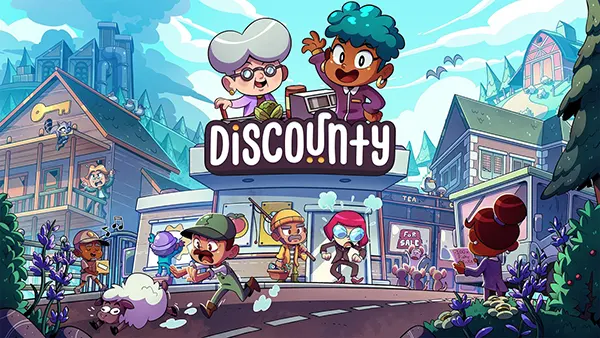
Discounty: Supermarket Manager brings together two ideas that are usually treated as separate genres: the routine of running a small supermarket and a character-driven story about a town dealing with economic change. Developed by Crinkle Cut Games and published on mobile by Snapbreak Games, the iOS and Android edition was released in August 2026 after the original game had already spent a year on PC and consoles. That timing matters because mobile players receive a much more complete version of Discounty than players saw at its original 2025 launch. The current edition combines the main campaign with later updates, including the People or Profit? story expansion. The result is a management game in which arranging shelves, ordering goods and serving customers are important, but they are only part of the larger picture. The supermarket sits at the centre of Blomkest, a struggling harbour town whose residents have their own disputes, loyalties and opinions about the growing business.
Mobile Release and the Core Shopkeeping Loop
The mobile edition retains the full structure of Discounty rather than reducing it to a simplified supermarket mini-game. The current App Store description places the main single-player campaign at roughly 15 to 20 hours, although the total time can grow when optional conversations, side objectives and the additional 2026 content are taken into account. Players can try the first few in-game days without paying and then unlock the full game with a single purchase. This approach is useful for a management title because the opening section introduces the basic rhythm of the supermarket before the player has to decide whether to continue. There is no need to understand a complicated economic model at the start. The game gradually introduces stocking, shop layout, customer service, trade agreements and expansion, giving each system enough space to become familiar before adding another responsibility.
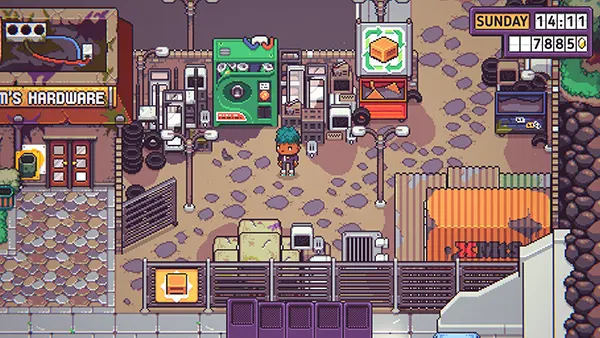
The supermarket itself is the main working space. Shelves can be moved and products rearranged, allowing the shop floor to change as the product range becomes larger. A cramped layout can make the store awkward to navigate, while a cleaner arrangement makes it easier to see what is running low and where customers are heading. Stock also has to be moved from storage onto the shelves rather than appearing automatically. Floors need attention, the back room needs organisation and customers expect to be served without unnecessary delays. These jobs are deliberately straightforward, but together they create a steady flow of small decisions. Spending the entire day concentrating on the till may leave shelves empty, while placing too much stock without thinking about demand can tie up money that could have been used for useful improvements.
Progress comes from reinvesting what the shop earns. New products, more selling space and store improvements gradually increase the amount of work that can be handled during each trading day. Discounty does not attempt to reproduce every detail of real supermarket accounting, and that restraint helps keep the management side accessible on a phone or tablet. The important questions are easy to understand: what should be stocked, where should it be placed, which improvements are worth paying for and how quickly should the business grow? At the same time, expansion is not treated as an isolated score-chasing exercise. The larger Discounty becomes, the more visible its influence on Blomkest becomes as well. That connection between ordinary shop decisions and the town’s story is what separates the game from management titles built almost entirely around increasing revenue.
What a Typical Day in Discounty Looks Like
A productive day usually begins with preparation rather than immediately serving customers. The player has to check what is already available, identify products that need replenishing and make sure there is room for incoming goods. As the supermarket develops, this becomes more important because a larger range means more shelves and more chances for an item to run out unnoticed. The storage area also needs to remain usable. Throwing goods into any available space might work when the shop is small, but it becomes inconvenient once several types of merchandise are being handled at once. This is where Discounty finds much of its management appeal. None of these tasks is difficult on its own, yet the game encourages the player to build a personal routine that makes the working day easier.
Once customers arrive, attention shifts from preparation to service. Products disappear from shelves, people move through the aisles and the checkout begins demanding more of the player’s time. Customers do not appreciate unnecessary waiting, so allowing a queue to grow while handling another job can create problems. The pressure remains mild compared with a demanding business simulator, but there is enough happening to make poor organisation noticeable. A well-prepared shop usually produces a calmer day because less time has to be spent correcting shortages. The design also means that improvements are easy to appreciate. A rearranged aisle, a better-stocked section or a more efficient checkout process can change the feel of the next trading day without requiring the player to study complicated statistics.
Closing the supermarket does not end the day’s useful activity. Time outside the shop gives the player an opportunity to move around Blomkest, speak with residents and work on objectives connected with the main story or individual townspeople. These conversations are not merely decorative additions between management sessions. Local residents can be connected to trade opportunities, speciality goods, personal requests and information about the town’s history. This creates a natural change of pace: the shop provides a repetitive working routine, while time in Blomkest moves the narrative forward. It also explains why focusing only on maximising daily income gives an incomplete picture of Discounty. Important opportunities are tied to people outside the supermarket, so understanding the town eventually becomes part of managing the business.
Growing Discounty Without Ignoring Blomkest
Blomkest is not simply a colourful background for the supermarket. The player arrives because Aunt Tellar has handed over responsibility for Discounty, the town’s only supermarket, but the local population is not universally enthusiastic about the arrangement. Some residents are suspicious of newcomers, while others have existing disagreements involving local businesses, employment and the direction in which the town is changing. The game uses these tensions to give ordinary commercial growth a more uncomfortable edge. Opening more selling space is positive from the supermarket’s point of view, yet residents may see the same expansion as another sign that one business is gaining too much influence. The player therefore spends much of the campaign caught between Tellar’s ambitions for Discounty and the needs or concerns expressed by people living around it.
Relationships with local residents also have a practical role. Manufacturers and other people around Blomkest can become important business contacts, and gaining their trust can lead to trade agreements that add local speciality products to the supermarket. This makes conversation and story progression relevant to the stock available on the shelves. Instead of simply opening a catalogue and buying every possible product as soon as enough money has been earned, the player often has to deal with the person connected to that part of the town. The system is not a deep negotiation simulator; agreements are integrated into quests and relationships in an approachable way. Its purpose is to make the supermarket feel dependent on its surroundings rather than like a completely separate business that happens to be located in Blomkest.
The tension becomes more noticeable as Discounty expands. Advertising attracts attention, a wider product range strengthens the shop and greater profits create further opportunities for growth, but commercial success does not automatically mean that every resident sees the changes as positive. The story repeatedly raises the question of what happens when an increasingly powerful retailer operates in a small community with limited alternatives. Discounty handles the subject with humour and exaggerated characters rather than turning into a serious economic drama, but the conflict remains important. The player is often carrying out tasks that are obviously good for Aunt Tellar’s business while hearing objections from people whose lives may be affected by those same decisions. That contradiction gives the routine of selling groceries a narrative purpose that continues beyond simply earning enough money for the next upgrade.
Trade Deals, Relationships and Store Expansion
Trade agreements are one of the clearest examples of the link between the two halves of the game. A new local product is more than another item that can generate income; it can represent progress with a particular resident or business. This gives some stock lines a history that ordinary supermarket simulators rarely provide. Players still need to think about practical matters such as shelf space and replenishment, but the reason an item becomes available may come from a conversation, favour or local dispute. The arrangement keeps the business systems understandable while giving additional meaning to the product range. It also encourages the player to leave the store after working hours rather than spending every available moment concentrating on the shop floor.
Store layout becomes increasingly important as the number of available goods rises. Early layouts can be simple because there are relatively few products to manage, but later expansions create more freedom and more opportunities to organise badly. Shelves have to fit into a space that customers can move through comfortably, while frequently sold products need to remain easy for the player to replenish. Decorative elements can also be added as the shop develops. The 2026 People or Profit? content broadens stock management further by allowing players more control over which products they want to sell and by adding 35 new items. This does not turn Discounty into a demanding logistics simulation, but it gives established shops more room for personal choices than the original release offered.
It is also important to understand that Discounty is a structured management game rather than an unrestricted supermarket sandbox. Major improvements and expansion are connected to story progress, so earning a large amount of money does not automatically allow every part of the shop to be developed immediately. Some goals have to be completed before the next stage becomes available. For players who enjoy completely independent business optimisation, that structure can occasionally feel restrictive. In return, it keeps the supermarket and narrative moving at approximately the same pace. New responsibilities usually appear when the player has already learned the previous ones, and larger changes to Discounty arrive alongside events that explain what the expansion means for the town. The design favours a guided campaign over endless economic experimentation.
Story Choices in the People or Profit? Expansion
The importance of story decisions changed substantially during 2026. At the original 2025 release, Discounty offered many conversations and conflicts, but its main story was much more guided than its premise sometimes suggested. Players could form opinions about Aunt Tellar, local residents and the supermarket’s expansion, yet many important events still moved towards the same general outcome. Feedback about the original ending was strong enough that Crinkle Cut Games returned to the issue with the free People or Profit? expansion. Rather than making a few minor changes to the final scenes, the developers added an entire fourth chapter after the previous ending. For someone starting with the 2026 mobile edition, this means the campaign now has a more substantial final stage in which the question raised throughout the game — business growth or community interests — receives a more interactive resolution.
In the new chapter, Aunt Tellar finally gives the player greater responsibility for the future of Discounty. The final questline branches according to decisions and alliances, leading to three different endings. This is the point at which story choices become more clearly consequential than they were during much of the earlier campaign. The player is no longer simply carrying out another stage of Tellar’s expansion plan; choices help determine what direction the supermarket and Blomkest take afterwards. The game does not suddenly become a vast branching role-playing adventure, and most of the earlier chapters remain comparatively structured. Instead, the expansion concentrates its strongest decision-making near the end, using the relationships and conflicts established during the main campaign as the basis for a final set of choices.
The expansion also adds new people whose interests complicate the situation further. Gaspard has plans connected with hydroponic farming, Angeel arrives with a luxury grocery business, and Casey operates a decidedly less conventional sales operation from a car. Their presence gives the final chapter new commercial and personal pressures rather than simply repeating existing disputes. The important point is that the new ending structure is based on alignment and decisions rather than on a single hidden statistic. Players can understand which people and priorities they are supporting through the choices they make. Progress is saved at the beginning of Chapter 4 as well, allowing another ending to be pursued later without replaying the entire original campaign from the first day.
How the 2026 Mobile Edition Changes the Overall Experience
People or Profit? adds more than alternative endings. Blomkest can now be repaired through town-restoration projects, including neglected buildings that previously had little practical purpose. New shop gadgets expand the later stages of supermarket management, with options such as self-checkout equipment and an order-fulfilment system. Random shop events can interrupt an otherwise predictable working day and force the player to adjust plans, while the enlarged product range provides more freedom over what appears on the shelves. The player can eventually move out of Aunt Tellar’s old trailer and buy a permanent house as well. These additions make the post-expansion game broader than the original 2025 release without abandoning the simple daily routine on which Discounty is built.
The mobile release has also been receiving rapid maintenance updates since its arrival. The iOS version history in late August 2026 shows successive fixes involving cloud saving, controller behaviour, achievements and smaller quality issues. Early user reviews reported occasional problems with saving, character naming and selecting small objects on a touchscreen, so it would be inaccurate to describe the first mobile build as completely trouble-free. At the same time, Snapbreak and the developers have been issuing updates quickly, with several revisions appearing during the first days after release. For players using a phone, the main interaction remains simple enough for short sessions, but managing a crowded shop naturally benefits from a larger screen because shelves, products and customers can occupy a relatively small visual area.
Discounty therefore works best as a story-led management game rather than as a detailed business simulator. Its strongest routines are easy to understand: prepare the shop, keep goods available, serve customers, reinvest earnings and use quieter periods to deal with Blomkest’s residents. The earlier chapters provide most of the context and relationships, while the 2026 final chapter gives those themes a more meaningful decision point through three possible endings. Players looking for complex pricing models, staff departments or advanced financial planning will find the business systems deliberately light. Those interested in a structured supermarket routine with characters, local conflicts and a defined campaign receive a fuller experience on mobile than the original release offered, particularly because the later story expansion is already part of the current edition.